A month or so ago I signed up for the independent online newspaper Crikey Daily Mail. Almost straight away, they ran a series of articles investigating into where exactly our foreign aid goes to. Now I would have thought most of our $4.3 billion worth of tax dollars for foreign aid funnels through companies such as Oxfam or World Vision to help poor countries. Is that what you would have thought too?
A lot of Australians would be surprised to know that for nearly a decade one of Australia's most successful, although little known, aid companies and it's biggest casino operator were owned by the same company.
Click to read more...

Thursday, August 5, 2010

Tuesday, July 27, 2010
Thought for the day

{A disturbing reality}
Just a few days before Federal Parliament rose, the Gillard Government passed new Renewable Energy legislation that counts “waste” from woodchip mills as clean, green renewable energy. The Government refused to close this loophole that gives a huge subsidy to burn our forests for electricity. The Abbott Opposition was even worse; they tried to amend the legislation to make all forests available for power generation, bypassing even the woodchip mills.
Click to read more In our trip around Aus, we went to these old growth forests that have been so hard hit by the logging companies. The tension between the workers in these towns, and the environmentalists that lobby to save the untouched beauty of south-western Tasmania is hard not to notice.
.JPG)
A year or so ago, the logging industry got it's cash from selling woodchips to the Japanese (among others) for very cheap. They didn't need to spend anything to plant or maintain these trees, they just bulldozed their way in and chopchopchopped it all down.
We managed to find trail maps leading us to some of the oldest and biggest trees in the world, that were saved from logging. We traveled along the roads built by the logging companies, freaking out when truckies in their massive semi-trailers overtook us along the narrow dirt roads. A few (very, very few) areas of the forest have been protected from the logging industry. We arrived at one, in the Styx valley, and found this amazingly well maintained trail that meanders past hundred year old ferns and eventually leads to the majestic tree that saved the little area from near destruction.
.JPG)
I find it so unbelieveable that the government doesn't protect more of these forests. For such a small amount of money, going to such few people, we are wasting a priceless part of Australia. Of the world. All I can think is that we are so fortunate we have these passionate people litterally putting their lives on the line to save such small areas of untouched, beautiful wilderness.
.JPG)
.JPG)
The worst part of all is mapped out in the cartoon above. The problem is that more than 80% of all forests logged in NSW, Victoria, Tasmania and Western Australia go straight to the woodchip mill. Officially this is “waste” from sawlog operations but the truth is that the woodchip industry controls native forest logging in Australia. The industry sees a new market for woodchips as their salvation at a time when woodchip exports for paper making are in serious decline because finally the Japanese and other buyers are starting to refuse woodchips from native forests.
As a result of the fall in export woodchips, major companies such as Gunns in Tasmania are now considering whether to abandon forest logging and make the transfer to plantations with the assistance of industry restructure funding from the Federal and State Governments. To make this happen in Tasmania and to extend it to the other States we have to keep up the pressure on the industry and the politicians throughout this election period
8 out of 10 Australians want a stop to logging our forests (Galaxy Poll May 2010). A stop will reduce Australia’s CO2 emissions by nearly 10% (not to mention other benefits) yet our Labor and Liberal politicians tell us it is too hard to even cut 5% without paying billions of dollars of "compensation" to the coal, steel and aluminium industries.

.JPG)
{Welcome sign to Maydena}
A year or so ago, the logging industry got it's cash from selling woodchips to the Japanese (among others) for very cheap. They didn't need to spend anything to plant or maintain these trees, they just bulldozed their way in and chopchopchopped it all down.
We managed to find trail maps leading us to some of the oldest and biggest trees in the world, that were saved from logging. We traveled along the roads built by the logging companies, freaking out when truckies in their massive semi-trailers overtook us along the narrow dirt roads. A few (very, very few) areas of the forest have been protected from the logging industry. We arrived at one, in the Styx valley, and found this amazingly well maintained trail that meanders past hundred year old ferns and eventually leads to the majestic tree that saved the little area from near destruction.
.JPG)
{Styx valley}
I find it so unbelieveable that the government doesn't protect more of these forests. For such a small amount of money, going to such few people, we are wasting a priceless part of Australia. Of the world. All I can think is that we are so fortunate we have these passionate people litterally putting their lives on the line to save such small areas of untouched, beautiful wilderness.
.JPG)
{the 'big tree' reserve}
.JPG)
{the 'chapel tree'}
The worst part of all is mapped out in the cartoon above. The problem is that more than 80% of all forests logged in NSW, Victoria, Tasmania and Western Australia go straight to the woodchip mill. Officially this is “waste” from sawlog operations but the truth is that the woodchip industry controls native forest logging in Australia. The industry sees a new market for woodchips as their salvation at a time when woodchip exports for paper making are in serious decline because finally the Japanese and other buyers are starting to refuse woodchips from native forests.
As a result of the fall in export woodchips, major companies such as Gunns in Tasmania are now considering whether to abandon forest logging and make the transfer to plantations with the assistance of industry restructure funding from the Federal and State Governments. To make this happen in Tasmania and to extend it to the other States we have to keep up the pressure on the industry and the politicians throughout this election period
8 out of 10 Australians want a stop to logging our forests (Galaxy Poll May 2010). A stop will reduce Australia’s CO2 emissions by nearly 10% (not to mention other benefits) yet our Labor and Liberal politicians tell us it is too hard to even cut 5% without paying billions of dollars of "compensation" to the coal, steel and aluminium industries.

Monday, July 26, 2010
Movement of the people
Our political situation is in a depressing state. Australia watches in amazement as the two major parties bicker and rip into each other about their choice of fashion (getting paid our tax dollars), while the largest issue our generation has ever seen gets pushed aside. Labor's new climate change policy is appaling, and the alternative is an economically-illiterate party whose leader doesn't believe in climate change at all - who insists on wasting $3b on the most expensive possible means of addressing it. Neither of the parties have our best interests at heart.
All we can do is read up on as much as we can. Keep informed and try to make the best choices when it comes time.
Here's something to get us started.
All we can do is read up on as much as we can. Keep informed and try to make the best choices when it comes time.
Here's something to get us started.
Thursday, July 1, 2010
Quick and easy dinners (part 1): Morroccan lamb cutlets
I'm starting this series for my gorgeous friend T who has convinced herself she is domestically challenged from a few traumatic (fiery) kitchen experiences. These chops are easy to prepare when you have a distractingly cute dinner guest, or if you need a quick meal for one after a busy day.

Chop the garlic finely, put into a bowl and mix with with a drizzle of olive oil and half the cumin and coriander seeds. Rub this mixture into the lamb cutlets on both sides. Line your grill tray or an oven tray with a large piece of foil (you want to be able to wrap all the cutlets up in this later). Heat to med-high and put the cutlets on to cook.

Fresh Ingredients
4 cloves of garlic
6 lamb chops
2 tablespoons Greek yogurt
Cupboard Ingredients
olive oil
2 tablespoon ground cumin
2 tablespoon ground coriander seeds
1 tablespoon chili powder
1.5 cups couscous
2 tsp vegetable stock powder
1/2 cup lemon juice
small handful each of pine nuts and sultanas (optional)
Chop the garlic finely, put into a bowl and mix with with a drizzle of olive oil and half the cumin and coriander seeds. Rub this mixture into the lamb cutlets on both sides. Line your grill tray or an oven tray with a large piece of foil (you want to be able to wrap all the cutlets up in this later). Heat to med-high and put the cutlets on to cook.
Meanwhile, in a saucepan, put 1 cup of water with the lemon juice, stock powder, chili powder and the rest of the cumin and coriander seeds and bring to a boil. Check on the cutlets. Turn them when the first side has gotten nice and brown.
When boiling, turn off the heat add the couscous and cover. Leave for at least 3 minutes. Keep watching the lamb. When both sides are brown, turn off the heat and fold up the foil so the cutlets can stay warm and moist and absorb the roast garlic and the other flavors.
When the 3 minutes is up, take off the lid, drizzle a little olive oil and fluff up all the couscous, adding the sultanas and pine nuts. Put the lid back on to keep it warm.
To serve, spoon the couscous onto the plates, top with the cutlets (making sure you don't waste the juices) and finish with a dollop of Greek yogurt.
Bonn appetite! (or whatever they say in Morocco...)
Bonn appetite! (or whatever they say in Morocco...)
Wednesday, June 23, 2010
Squid salad with roast eggplant, baby carrots and rice wine vinagrette

{squid salad}
Whenever we make the trip out to the Pyrmont fish markets, we're never disappointed. There's always taste testing and various specials on really fresh seafood. Sometimes I buy salmon, kingfish and tuna sashimi thinly sliced so I can make lots of nigiri (my favorite). This time we picked up a few hoods of Australian squid, as well as the freshest Aussie tiger prawns they had.
This recipe was inspired by all the eggplant and baby carrots we found on special at the fruit and veg store. You can use whatever salad ingredients you have in your fridge. Cherry tomatoes, cucumber, roast zucchini or capsicum would also go really well.
Squid Salad
1 large squid hood, cleaned
1/4 cup plain flour
1 tablespoon chilli flakes
pinch of salt & black pepper
Oil for frying
1 medium eggplant, sliced thinly
10 baby carrots
salad greens (I used baby spinach and rocket)
Vinaigrette
juice of 1 large lemon
2 tablespoons rice wine vinegar
2 tablespoons olive oil
salt
Heat oven to med-hot. Rub salt and olive oil into the eggplant, and place on a baking tray. Bake for 15-20 minutes, turning once.
Blanch carrots in boiling water for about 5 minutes until slightly tender but still bright orange.
Fill a supermarket fruit and veg bag with the flour, chilli flakes and S&P. Open up the squid tube by slicing length ways. Score the inside of the tube so it's all criss-crossy, then chop into pieces 1 by 2 inches. Put all the pieces in the bag and give it a good shake to coat.
Heat oil in a frying pan so it's nice and hot, and lay out the squid pieces (but don't overcrowd them). After about 3 minutes the pieces should be browned on one side, so turn them over. When the other side is brown, remove from the pan and place on a plate lined with paper towel.
For the vinaigrette, put all ingredients into a jar and shake well.
Assemble greens, eggplant, carrots, squid in a nice salad bowl, pour over the vinaigrette and enjoy!
Makes dinner for two big eaters!
Takes 30 mins
Cost $10
Monday, June 21, 2010
Bliss Balls

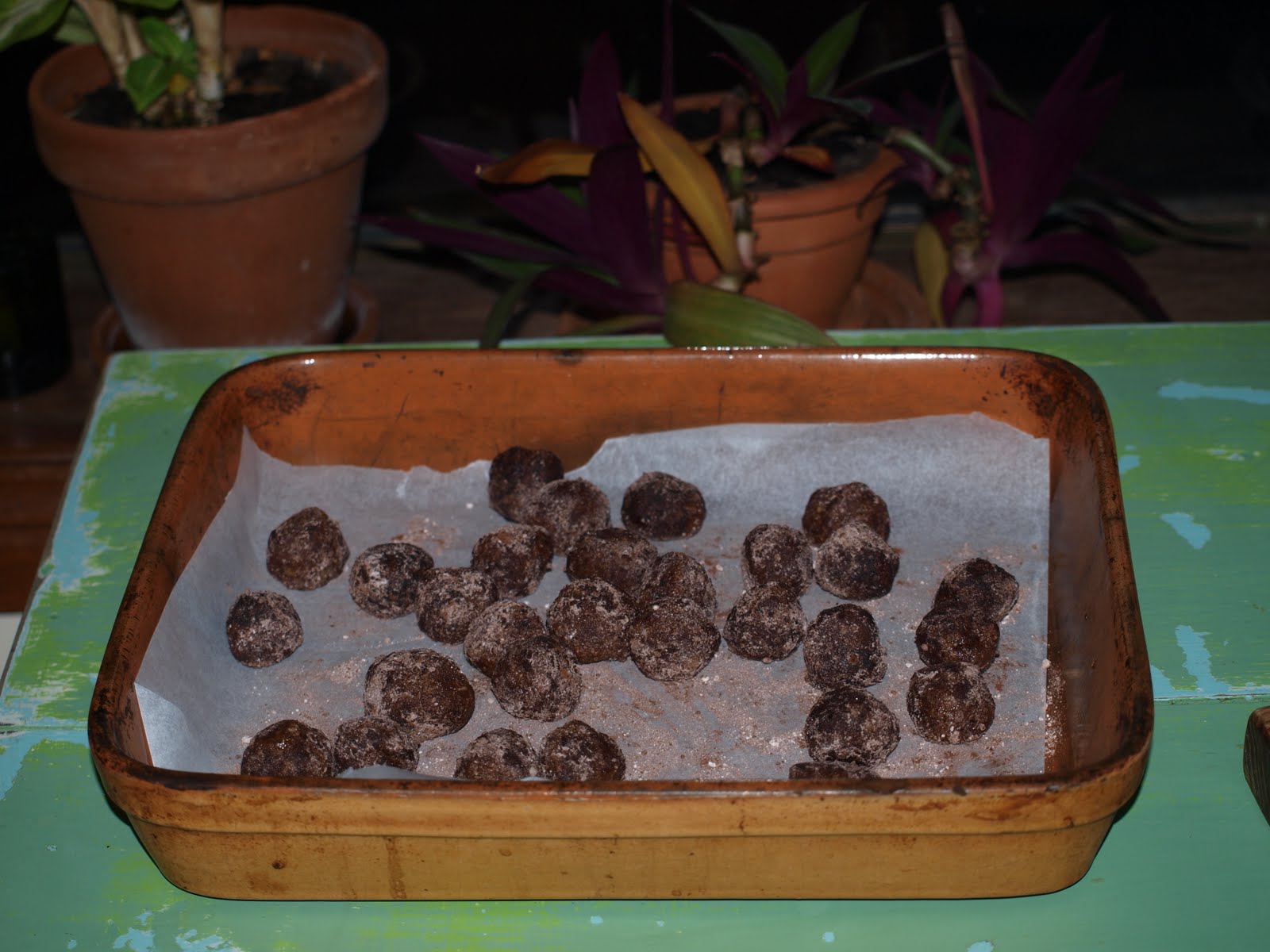
{blissed out}
These little truffles are so easy to make and make a good after dinner treat. And you know that blah feeling you get after downing half a block of cadbury? None of that here. All natural, vegan and so yum...
1 cup shredded coconut
7 dried dates chopped finely
1/3 cup walnuts chopped finely (i just use a mortar and pestle)
3 tablespoons tahini
2 tablespoons peanut butter
2 tablespoons honey
2 tablespoons cocoa powder + more to coat
1 tablespoon brown sugar
You can substitute the walnuts with any other crushed nuts, and almond meal is a good addition. Sesame seeds would also go well in these. I added a bit of brown sugar because I love the taste, but you can replace with more honey or whatever you like best.
Combine all ingredients in a bowl and mix well. If its too runny, add more dry ingredients like coconut and if its not moist enough then add more honey or tahini or even a bit of water.
Roll into little balls and then roll in extra cocoa powder. Allow to set on a plate in the fridge for 30 mins. Store in a container in the freezer for a yummy treat whenever.
Makes about 30
Takes 30 mins
Cost around $5
Friday, June 11, 2010
Clean, Green.

{http://climateprogress.org/2008/04/30/a-vicious-cycle}
Click to read more on "Clean, Green"
In response to the failure of Copenhagen, the Bolivian government called this People's Conference, which ran over four days and was attended by over 35 thousand people. People came together from all over the world to discuss real action on the climate crisis. The end result was The World People's Agreement, a formal document being discussed at the Bonn UN climate negotiations right now, providing new hope for people fighting for global climate justice.
This isn't the first climate event I have attended, and it wont be the last. I always come away from them learning many things that I would never have had the chance to. A few points that I took away from S & N's experience was:
- The people in Bolivia have been so adversely affected by the climate crisis that it has brought communities together in big conferences like the World People's Conference. Climate change is the topic of conversation daily in these people's lives.
- Glaciers are the life-force of many in South America and around the world. In Bolivia they have been worshipped for thousands of years and soon this will not be possible. In the last 40 years climate change has reduced these Glaciers by over 50%. Some have completely melted away during that time. For thousands of years the people in communities surrounding the Glaciers have lived off the melt in the dry seasons, and watched as the glaciers restored themselves yearly during the wet season. Now they watch helplessly as their remaining glaciers melt away rapidly with little or no hope of restoration.
- Coal exports are Australia's biggest contribution to the climate crisis. The greenhouse pollution from our coal exports exceeds all of our domestic pollution combined. Every power station, every landclearing operation, every car, truck, train, and bus, every source of greenhouse pollution in Australia combined is eclipsed by the pollution from our coal exports. Burning a tonne of black coal produces 2.4 tonnes of greenhouse gases, and the mining, processing and transportation of coal contributes enormously to greenhouse gas production.

As Australians it is easy to be ignorant about climate change. It's hard to appreciate the perils of those whose lives are being so severely affected by the climate crisis when in the comfort of our homes we can control our environment. The majority of the world get to see the changes first-hand. My hope is the developed world change to a greener way of living before it's too late.
It's so inspiring to see that after the complete failure of Copenhagen people haven't lost hope. Through everyone sharing their knowledge and experiences we can build up more awareness and help us better handle this issue which will eventually affect our lives a great deal.
To read more about S & N's insights go here.
To read more about S & N's insights go here.
Subscribe to:
Posts (Atom)
- Coffey International, the Chatswood, Sydney-based "global professional services consultancy", took more than $300 million in contracts in 2009 alone (from AusAid records)
- Cardno ACIL secured at least $270 million, as did GRM, "a leading international development management company"
- Queensland companies GHD and JTA international, both reaped over $100 million.
The idea that most (over 60%) of our "foreign aid" ends up back in Australian's pockets is called "Boomerang Aid", and has long been a basis of criticism of AusAID. But one thing I found quite interesting is the company GRM International Pty Ltd- GRM international handles hundreds of millions of dollars worth of government contracts each year, yet according to its most recent financial statements, GRM International pty Ltd doesn't make a profit (it hasn't reported a single cent in over a decade) and hasn't had any employees since 2005.
- These accounts are surprising because according to government records, GRM secured more than a billion dollars worth of AusAID contracts between 2001 and 2010, as well as income from its agribusiness actuvities.
- The contracts are for "technical assistance" in the form of short-term contracts for expert advisers. This form of aid is more common in Australia than in other OECD countries and has been criticised by a recent review of Australian aid to PNG as often ineffective, wasteful and lacking in accountability.
- All these contracts are published on the 'federal government's tender data base' but details are often vague, such as over $350,000 over two years to "strengthen accountability" and another million for "governance and related activity"
Decide for yourself, but this sounds quite sus to me. Stay tuned, I'll let you know what I find out...